 Play Designer
Route tree
The Football Route Tree Explained: Every Route from 0 to 9, with Diagrams
The football route tree from 0 to 9, with a diagram of every route, depths for youth and high school, what beats man and zone, and a printable route tree PDF.
The route tree is the short list of passing routes every receiver learns, each with a number. Instead of explaining a route in the huddle, the coach calls a number and the receiver knows exactly where to go: how deep to run, and which way to break.
This guide covers the standard wide receiver route tree from 0 to 9: every route drawn, depths for youth and high school, what beats man and zone, and how to teach it to kids. Tap Watch it run under any diagram to see the route animated, and print the handout and wristband cards at the end.
The route tree at a glance
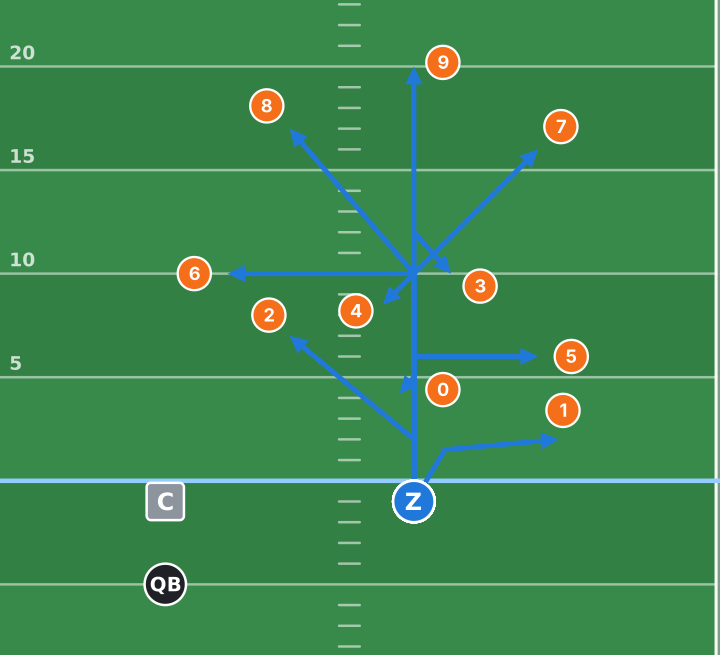
The tree is drawn for a receiver lined up on the right side of the formation, so "outside" means toward the right sideline and "inside" means toward the middle of the field. Every route starts the same way, straight up the field (the stem), then branches off at a set depth. Drawn together, the routes look like the branches of a tree, which is where the name comes from.
| # | Route | Breaks | High school depth |
|---|---|---|---|
| 0 | Hitch | Inside, back to the QB | 5 yards |
| 1 | Flat | Outside | 2 yards |
| 2 | Slant | Inside, at an angle | 2 yards |
| 3 | Comeback | Outside, back toward the sideline | 12, back to 10 |
| 4 | Curl | Inside, back to the QB | 10, back to 8.5 |
| 5 | Out | Outside, flat | 6 yards |
| 6 | Dig (In) | Inside, flat | 10 yards |
| 7 | Corner | Outside, deep | 10 yards |
| 8 | Post | Inside, deep | 10 yards |
| 9 | Go | Straight | All the way |
Depths are measured from the line of scrimmage, the way coaches call them ("a 5-yard out"), so a slot receiver lined up a yard off the ball breaks at the same depth as the receiver on the line.
Odd routes go out, even routes go in
The numbers aren't random. In the standard tree, odd numbers (1, 3, 5, 7) break outside toward the sideline, even numbers (2, 4, 6, 8) break inside toward the middle, and the 9 goes straight. The numbers also get deeper as they climb: the 1 and 2 are quick, the 3 to 6 are intermediate, and the 7 to 9 are deep.
That gives players a simple memory rule: odd out, even in. A receiver who forgets what a 7 is can still remember it breaks outside and it's one of the deep ones.
The tree works on both sides of the field. A receiver on the left runs the same numbers, mirrored, so receivers only think "in" or "out", never left or right.
Every route, one at a time
Each diagram shows one receiver (Z, with the star) on the right, at high school depths. The numbers on the left are yards from the line of scrimmage.
0: Hitch
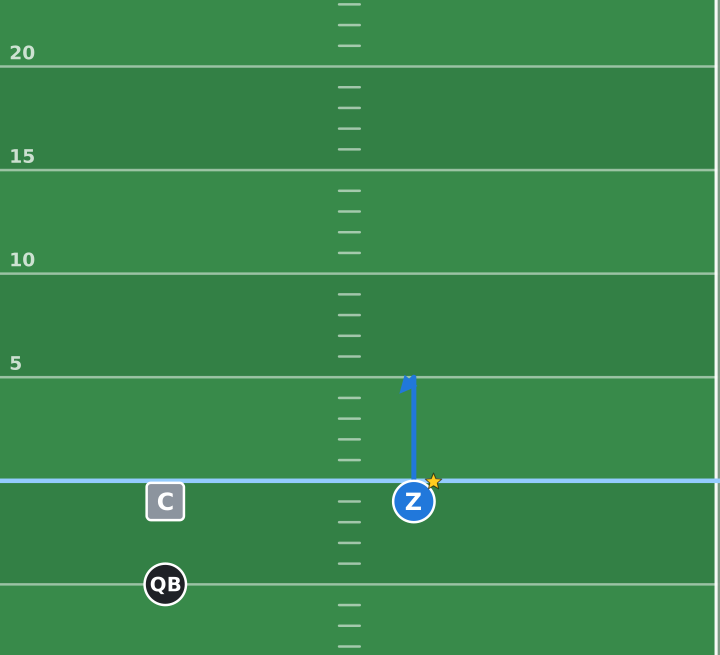
Push hard upfield for 5 yards as if running a go, then stop, turn back inside and face the quarterback. The hitch is a timing throw: the ball should be on its way as the receiver turns. It's the best answer when the defender is playing far off the receiver.
1: Flat
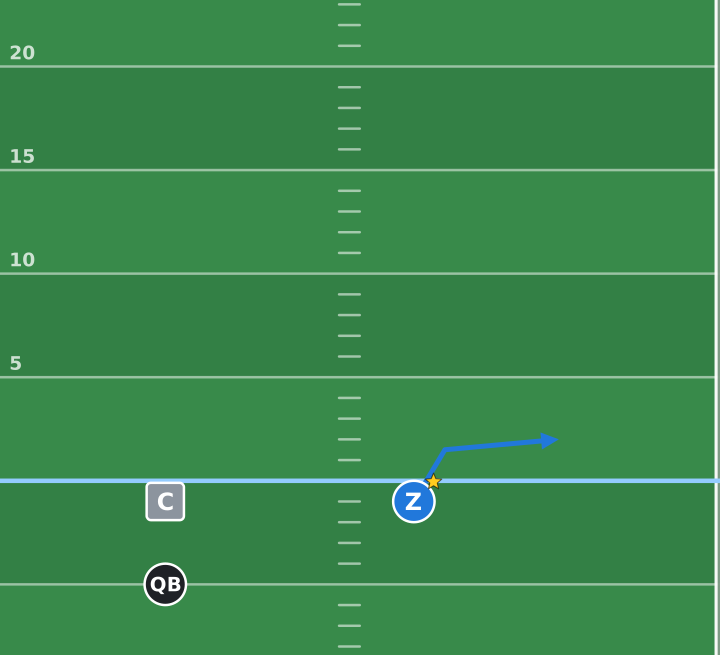
A quick step up, then flatten out toward the sideline about 2 yards past the line. The flat is usually run by a slot receiver or a running back, and it's the low half of a lot of concepts. The receiver should look for the ball early.
2: Slant
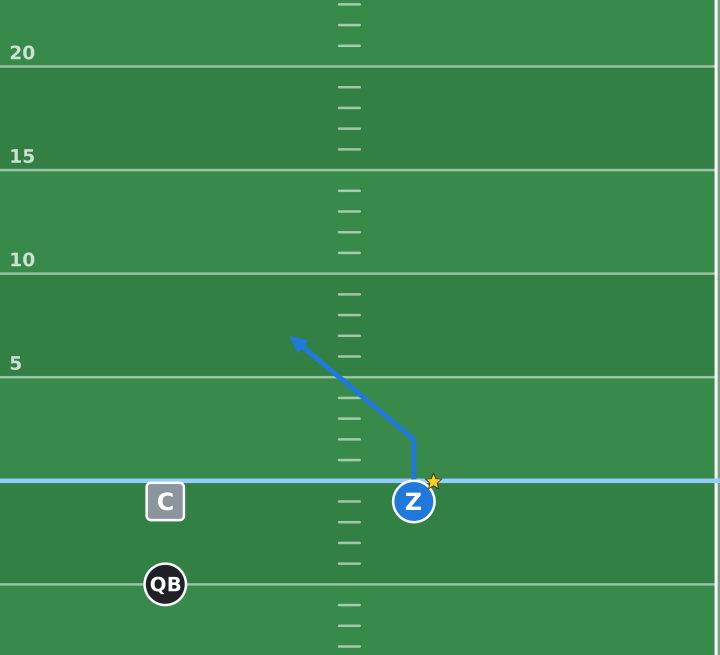
Two hard steps upfield, then cut inside at about 45 degrees and keep running across the field. The quarterback hits the receiver on the run, in front of the defender. The slant is the most useful quick route in football and the first one most teams teach.
3: Comeback
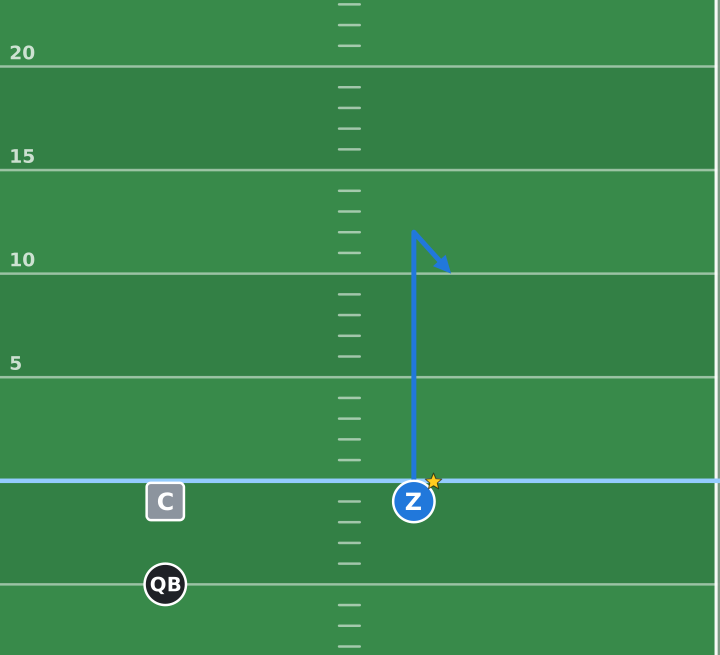
Sell the go route to 12 yards, then plant, turn back toward the sideline and come back to about 10. The comeback works when the cornerback is running scared, worried about getting beat deep. It needs a quarterback who can throw to the sideline on time, so it's a better fit for older players.
4: Curl
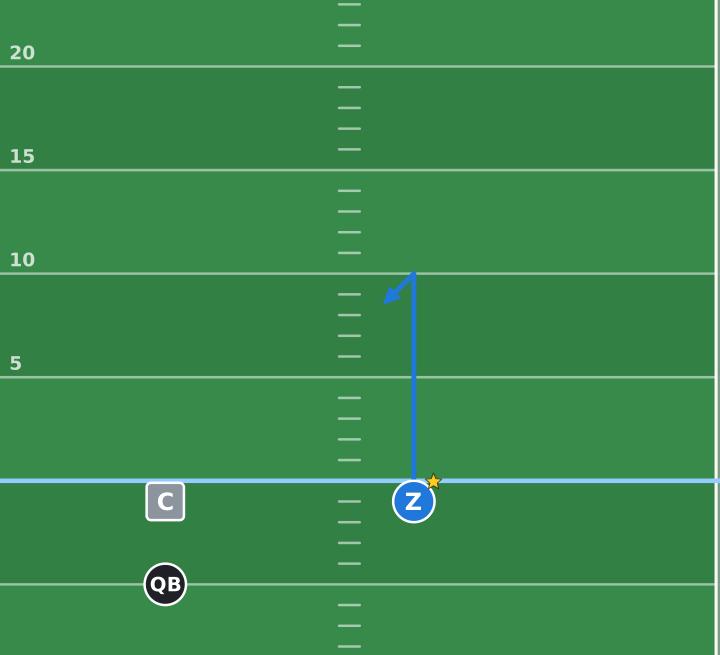
Run to 10 yards, then turn inside and come back a step or two toward the quarterback. Against zone coverage, the receiver settles in the open space between defenders.
5: Out
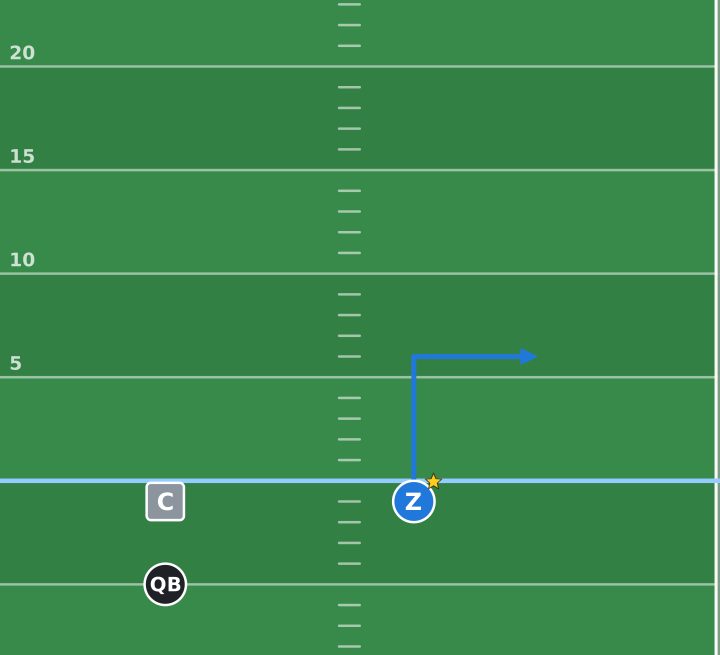
Run to 6 yards, plant on the inside foot and break flat toward the sideline. The cut should be square, not rounded, or the defender will undercut it. The out is a reliable chain-mover when the corner is playing soft.
6: Dig (In)
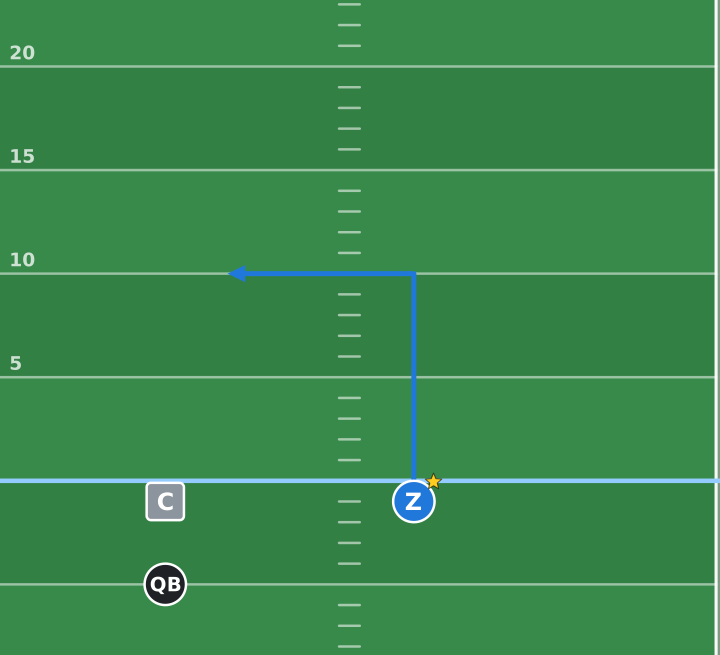
Run to 10 yards, then break flat inside across the field. The receiver finds the hole behind the linebackers and keeps moving through it. Some programs call a shorter version (5 or 6 yards) the in and save dig for the deeper one; the shape is the same.
7: Corner
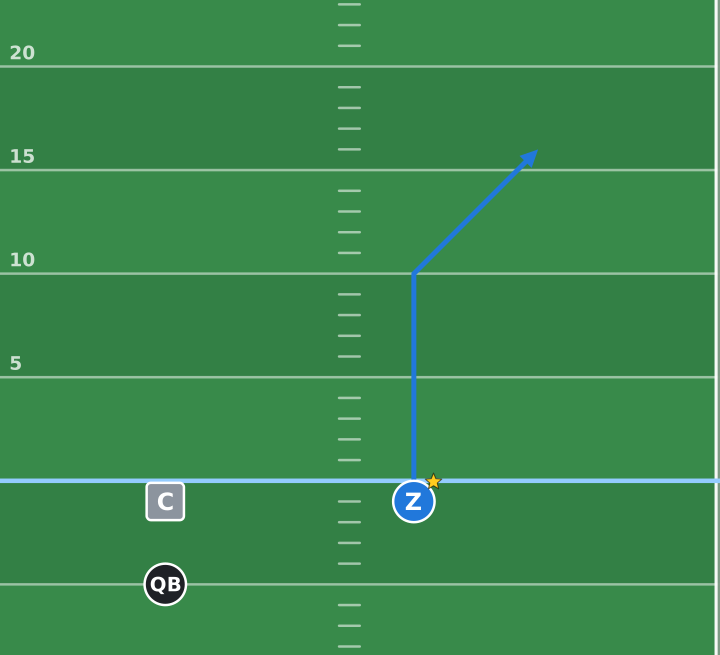
Run to 10 yards as if going deep, then angle out toward the back corner of the end zone. The ball comes over the receiver's outside shoulder. The corner is a classic answer to Cover 2, where it attacks the hole between the cornerback and the deep safety.
8: Post
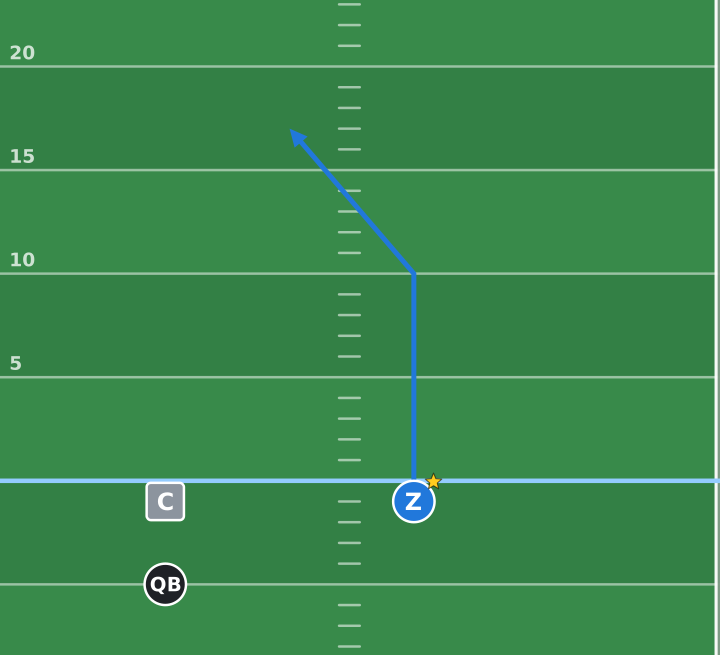
Run to 10 yards, then angle inside toward the goalposts, which give the route its name. The post attacks the middle of the field deep, especially when there are two safeties who each have to cover a deep half.
9: Go
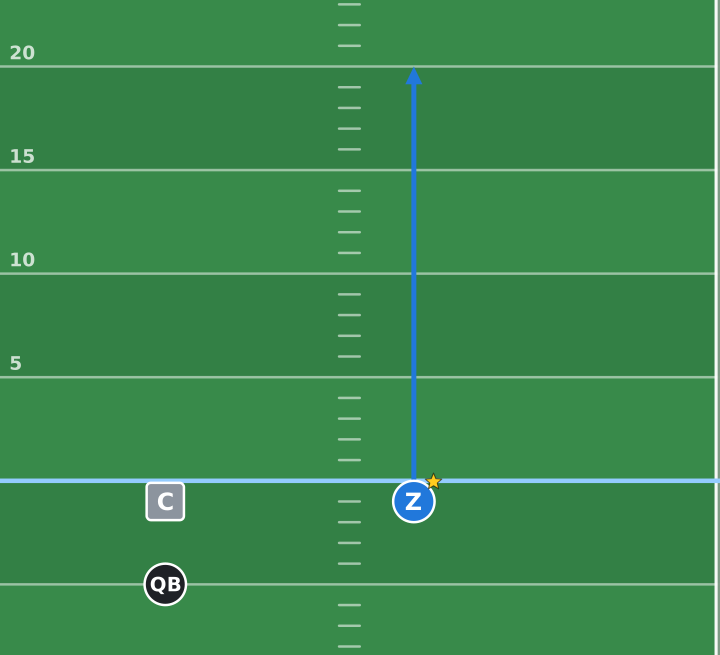
Win off the line and run straight up the field at full speed. You'll also hear it called a fly or a streak. The receiver should look back late, and the ball should drop in over his outside shoulder. Even when it isn't thrown, the go clears defenders out of the way for shorter routes underneath.
See all ten routes run, in any phone browser:
Route tree numbering varies by program
There is no single official route tree. The 0 to 9 tree above is the most common version, but programs change it, and that's fine as long as your whole team uses the same one. Variations you'll run into:
- No 0. Some trees start at 1 and treat the hitch as a short curl, or call it by name only.
- Different short routes. Some trees put a quick out at 1 or 3 instead of the flat or the comeback.
- The 3 and 5 swapped, so the out is a 3 and the comeback is a 5.
- Names for the same route. The go is also a fly, streak or 9. The dig is also an in or a square-in. The hitch is also a stop or a quick curl.
- Named routes outside the tree, such as the drag, wheel, swing and fade, that teams call by name instead of number.
Whatever numbering you use, keep the odd-outside, even-inside rule if you can. It's the part that makes the tree easy to learn.
Numbers also let you call several routes at once. In a call like "Twins 92", one receiver runs a 9 and the other a 2; Air Coryell offenses use three-digit calls such as 896. Which receiver reads which digit is up to your system, so teach it the same way every time.
Depths for youth vs high school
The depths in the table are for high school receivers. Younger players can't run or throw that far in the time they have, so shorten the whole tree, not just one route. The break depths in Play Designer scale with the format:
| Route | 11-man (high school) | 7v7 and 8-man | 5v5 and 6v6 flag |
|---|---|---|---|
| 0 Hitch | 5 | 4.5 | 3.5 |
| 1 Flat | 2 | 1.5 | 1.5 |
| 2 Slant | 2 | 1.5 | 1.5 |
| 3 Comeback | 12 → 10 | 10 → 8.5 | 8 → 6.5 |
| 4 Curl | 10 → 8.5 | 8.5 → 7 | 6.5 → 5.5 |
| 5 Out | 6 | 5 | 4 |
| 6 Dig | 10 | 8.5 | 6.5 |
| 7 Corner | 10 | 8.5 | 6.5 |
| 8 Post | 10 | 8.5 | 6.5 |
Yards from the line of scrimmage, rounded to the half yard. For youth tackle the rule is the same: the right depth is the one your quarterback can throw on time. If he can't get the ball 10 yards to the sideline, the comeback isn't in your playbook yet.
Which routes beat man and zone
Defenses play two basic kinds of coverage. In man, each defender follows one receiver. In zone, each defender covers an area and reacts to whoever comes into it. Routes beat them in different ways.
Against man, win with sharp cuts and speed. The receiver wants to break away from the defender's position: a slant when the defender lines up outside him, an out or comeback when the defender lines up inside or plays far off. Against tight press coverage, a go route that wins at the line is the big play.
Against zone, find the holes. Routes that stop and settle (the hitch, curl and dig) sit down in the space between defenders. The flat and the out attack the edges, and the corner and post attack the deep spaces between safeties.
| Route | Best against |
|---|---|
| 0 Hitch | Off coverage, soft zone |
| 1 Flat | Zone; defenders who can't get wide in time |
| 2 Slant | Man with outside leverage; windows in zone |
| 3 Comeback | Off man; corners who bail deep |
| 4 Curl | Zone, sitting in the hole |
| 5 Out | Off coverage; corners playing deep |
| 6 Dig | Zone, behind the linebackers |
| 7 Corner | Cover 2; man with inside leverage |
| 8 Post | Two deep safeties; man |
| 9 Go | Press man; one-on-one with no deep help |
Combining routes into concepts
Single routes are easy to cover. Two or three routes run together, so one defender has to choose, are much harder. That's a passing concept, and most concepts are just route tree numbers in a smart combination:
- Slant-Flat (2 + 1): the outside receiver runs a slant and the inside receiver runs to the flat. The defender between them can't cover both.
- Curl-Flat (4 + 1): the same idea, deeper. If the defender widens with the flat, throw the curl.
- Smash (0 + 7): a hitch outside with a corner over it from the slot. If the cornerback sits on the hitch, throw the corner. It's a Cover 2 beater.
- Flood: a go, an out-breaking route at middle depth and a flat, stacked on one side, so the defense is outnumbered at three levels.
- Four Verticals (9s): four receivers go deep at once, more than most defenses can cover.
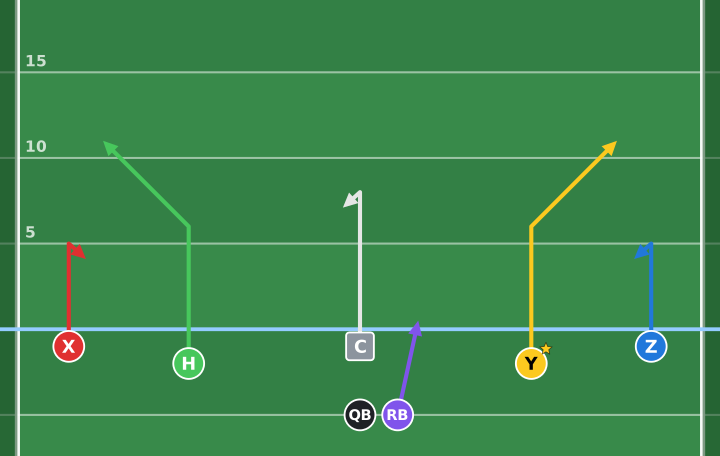
You'll find these drawn, animated and explained in our 5 simple 5v5 flag plays and 7 on 7 flag football plays, each with the quarterback's read.
How to teach the route tree to kids
Young players can learn the tree, but not all of it at once. A plan that works:
- Start with three routes. The slant, the out and the go cover quick, medium and deep, and one breaks each way. Add the hitch next, then the rest as players are ready.
- Use names first, numbers second. Kids remember "slant" before they remember "2". Once the routes are sharp, attach the numbers.
- Teach odd out, even in. Say it every practice. It turns ten routes into one rule.
- Count steps, not yards. Young players can't judge 5 yards on the run, but they can count steps. Put a cone at each break point, and have them count their steps to it so the depth stays the same when the cones are gone.
- Run it on air, then against a defender. No defense until every receiver knows the depth and the cut.
- Sell the stem. Every route should look like a go for the first few steps, so the defender has to guess.
- Put it on their wrist. A route tree wristband card means no one has to remember it mid-game.
Players can study at home too: send the team link above and they can watch every route on a phone, no app needed.
How the route tree works in Play Designer
Play Designer has the numbered route tree built in. Tap a receiver, then tap a number, and the route draws itself, breaking inside or outside depending on which side of the ball the player lines up. Depths scale to the format, from 4v4 flag to 11-man tackle, as in the depth table above. If your program numbers routes differently, you can renumber or rename any route in the playbook's Route Tree settings, so the app calls them what your players call them.
Free printable route tree
The handout has the full tree with a depth table, every route drawn, and a coaching sheet with a blank column for your own numbering. The wristband cards come in youth and adult sizes, plus a blank-number version for your program's numbers.
Our guide to making wristband play cards shows how to size, print and cut them, and the football wristbands page has card sizes, layouts and a blank template.
FAQ
What is a route tree in football?
A route tree is a numbered list of the basic passing routes a receiver runs, usually 0 to 9. Each number tells the receiver how deep to run and which way to break, so a coach can call a route with a single number.
What do the numbers in a route tree mean?
In the standard tree, odd numbers (1, 3, 5, 7) break outside toward the sideline, even numbers (2, 4, 6, 8) break inside, and 9 is a go route straight up the field. Low numbers are short routes and high numbers are deep routes. Many trees use 0 for the hitch.
Is the route tree the same for every team?
No. The 0 to 9 tree is the most common, but programs change numbers and names, such as swapping the out and the comeback or calling the dig an in. What matters is that your whole team uses the same tree all season.
What routes should youth football players learn first?
Start with the slant, the out and the go: one quick route, one medium and one deep, breaking both ways. Add the hitch next. Shorten the depths for young players so the quarterback can throw on time.
What is the difference between a dig and an in route?
They have the same shape: run straight, then break flat to the inside. Many programs use "in" for a short version at about 5 or 6 yards and "dig" for a deeper one at 10 to 12 yards, but some use the names interchangeably.
More coaching guides
-
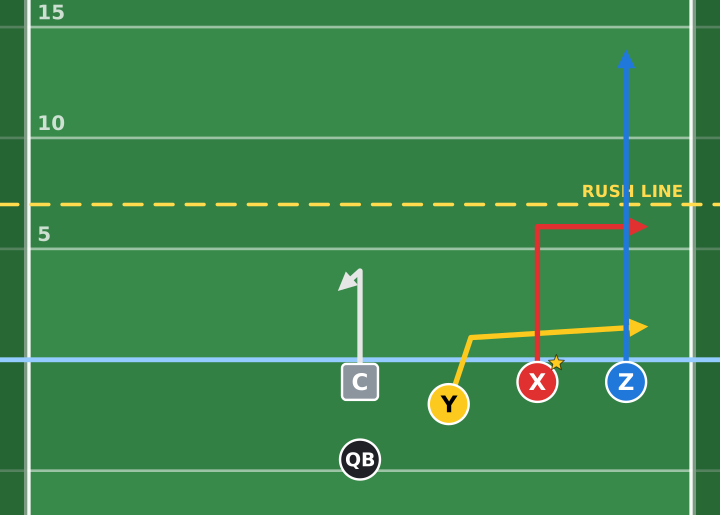 5v5 flag plays5 Simple 5v5 Flag Football Plays That Work (Free Printable Play Sheets)Five easy 5v5 flag football plays for youth teams, with diagrams, the quarterback's read for each, animated versions and free printable play sheets.
-
 7 on 7 flag plays7 on 7 Flag Football Plays: 6 Easy Passing Concepts (7v7)Six easy 7 on 7 flag football plays (Stick, Smash, Flood, Mesh, Four Verticals, Drive) with diagrams and the read, for flag leagues and 7v7 passing leagues.