 Play Designer
7v7 passing concepts
7v7 Football Plays: 6 Easy Passing Concepts for Beginners
Six 7v7 passing concepts for beginners (Stick, Smash, Flood, Mesh, Four Verticals and Drive) with diagrams, the read and what each one beats.
7v7 is football with nothing but the passing game. There are no linemen, no run game and a short clock, so the offense lives on a handful of passing concepts the quarterback can read in a couple of seconds.
A concept is a group of routes designed to work together against a defense. Learn the six below and you can run most of what 7v7 teams run: each one is just a different way to put two receivers on one defender, so whichever way he goes, someone is open.
Every diagram was drawn in Play Designer. Tap Watch it run under any concept to see it animated, and print the free play sheets at the end.
7v7 basics these plays assume
Tournament rules differ, so check yours. These concepts work under the rules most 7v7 events share:
- Seven players a side. On offense: a center who snaps and is eligible, a quarterback, a running back (RB) and four receivers, labeled X, H, Y and Z here.
- No rush and no run game. Instead the quarterback has a short pass clock, often around four seconds. Quick decisions win.
- Seven defenders, usually in a zone like Cover 2 or Cover 3, or man coverage with a free safety.
A few terms help. A high-low puts two receivers at different depths on one defender. A horizontal stretch spreads receivers across the field at the same depth. Receivers are numbered from the sideline in: the widest is #1, the next is #2, then #3.
How to read the diagrams: circles are players and the square is the center. The star marks the first read. Numbers on the left are yards from the line of scrimmage.
1. Stick
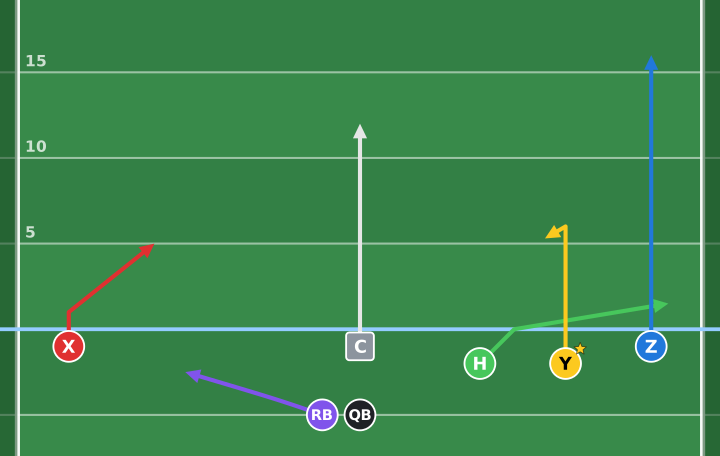
How it works. From trips right, Z (#1) runs a go to take the outside defender deep. Y (#2) runs a stick: 6 yards up, then turn inside to face the quarterback and sit. H (#3) runs to the flat. X runs a slant on the back side, the center splits the safeties, and the RB is the check-down.
The read. One defender, usually the outside linebacker, has to cover the flat and the stick. If he widens with H, throw the stick. If he stays on Y, throw the flat. The ball should come out in under two seconds.
What it beats. Zone coverage, especially when defenders play off. It is a great first concept to teach, and a reliable call when you need 5 or 6 yards.
2. Smash
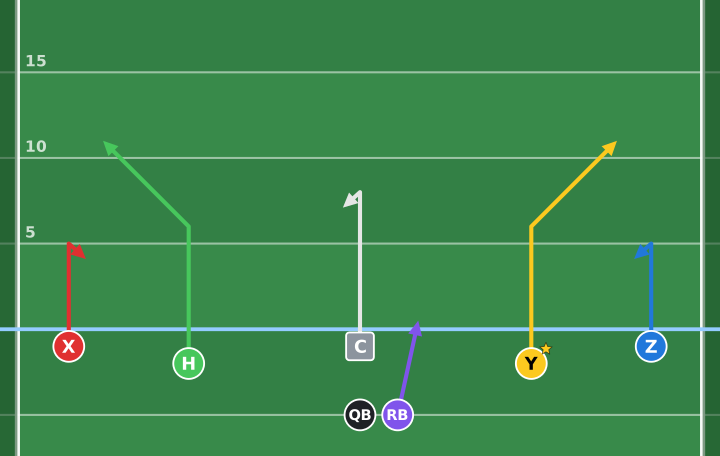
How it works. Both sides run the same pair of routes. The outside receivers (X and Z) run 5-yard hitches. The slot receivers (H and Y) run corner routes, breaking at about 6 yards toward the sideline. The center sits in the middle and the RB checks down over the ball.
The read. Pick a side before the snap, usually the side with more room. Then read the cornerback on that side. If he sits on the hitch, throw the corner over his head. If he drops with the corner, throw the hitch.
What it beats. Cover 2. In Cover 2 the cornerback plays the flat and the safety has the deep half, which leaves a hole along the sideline between them. The corner route goes straight into it.
3. Flood (Sail)
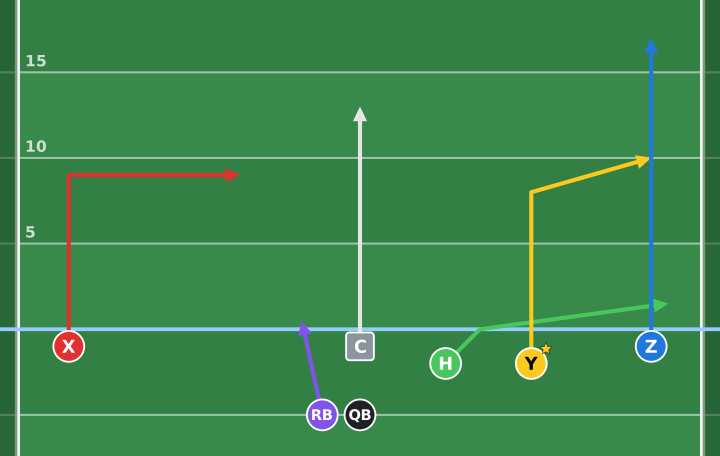
How it works. Three receivers fill one side of the field at three depths. Z runs a go (high), Y runs a sail, a deep out that breaks at about 8 yards and climbs to about 10 near the sideline (middle), and H runs to the flat (low). X runs a dig on the back side, the center goes up the middle to hold the safety, and the RB checks down.
The read. High to low. If the go is open deep, take it. If not, look at the sail, then the flat. The defenders covering that side are outnumbered three to two, so one level will be open.
What it beats. Cover 3. The cornerback has to run with the go, and the defender in the flat can't cover both the sail and the flat.
4. Mesh
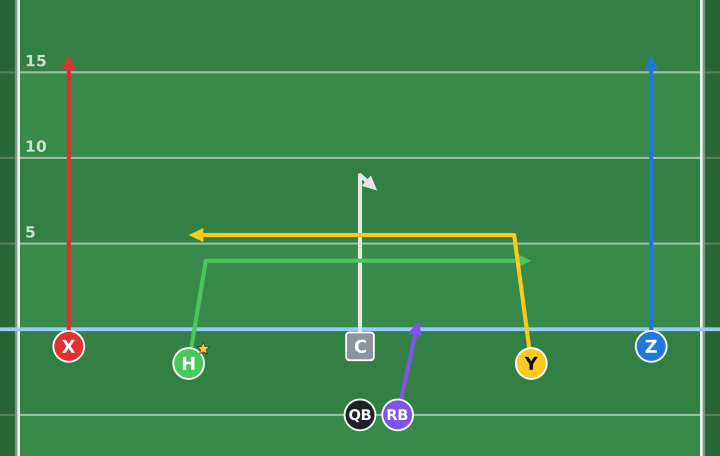
How it works. The two slot receivers cross in the middle at shallow depth: H underneath at about 4 yards, Y over the top at about 5 or 6, so they pass close to each other. X and Z run go routes to clear the defenders over them. The center sits at about 9 yards, and the RB checks down.
The read. Against man coverage, the defenders chasing the crossers have to work through traffic, and one crosser usually comes free. Hit him on the run. Against zone, the crossers sit down in the open windows instead of running into a defender.
What it beats. Man coverage. Teach receivers to pass each other, not defenders: deliberately running into a defender to free a teammate is a pick, which is offensive pass interference.
5. Four Verticals
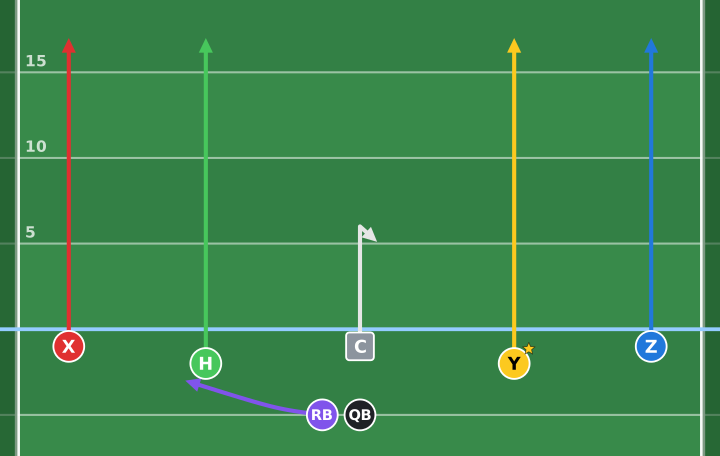
How it works. Four receivers go deep. X and Z run go routes outside, about 3 yards inside the sideline, and H and Y run straight up the seams. The center sits at 6 yards underneath and the RB swings to the left as the check-down.
The read. Watch the middle of the field before and after the snap. With one deep safety in the middle (Cover 3 or Cover 1), throw the seam on the side he doesn't move to. With two deep safeties (Cover 2), throw between them up the seam. If nothing is open deep, take the check-down. A completion underneath beats a forced throw.
What it beats. Any defense that can't cover four receivers deep at once, especially Cover 3.
6. Drive
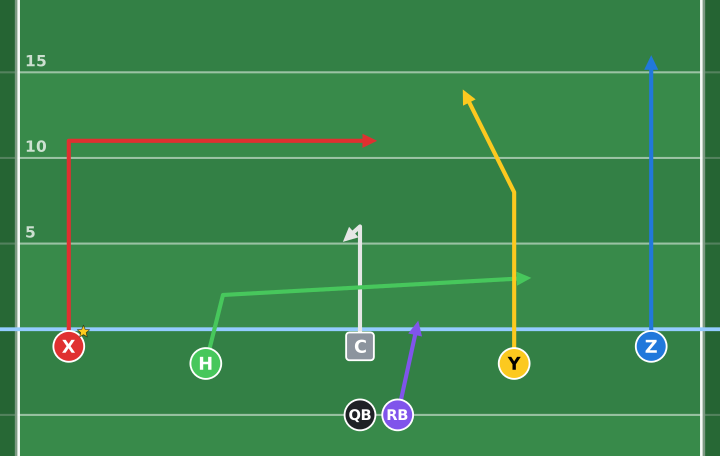
How it works. H runs a shallow cross at about 3 yards, and X runs a dig over the top of him at about 11 yards, both breaking to the right. Y runs a post and Z runs a go to clear the right side. The center sits at 6 and the RB checks down.
The read. Watch the defender in the middle of the field, usually the middle linebacker. If he comes up to take the shallow, throw the dig behind him. If he drops under the dig, throw the shallow.
What it beats. Zone coverage with one defender in the middle. It pairs well with Mesh: same idea, but the depths are different.
Which concept to call
| Concept | Beats | First read |
|---|---|---|
| Stick | Zone, soft coverage | Flat defender |
| Smash | Cover 2 | Cornerback |
| Flood | Cover 3 | High to low on the flood side |
| Mesh | Man coverage | The crosser who comes free |
| Four Verticals | Cover 3, single-high safety | Middle safety |
| Drive | Zone with a middle defender | Middle linebacker |
If you don't know what the defense is playing, start with Stick: it's quick, safe and works against almost anything. Then look at how they line up. Corners pressed tight usually means man (call Mesh), corners off with two deep safeties points to Cover 2 (call Smash), and three deep defenders points to Cover 3 (call Flood or Four Verticals).
How to install them
Teach two concepts per practice. Start with routes on air, no defense, so every receiver learns his depth and break. Then run the concept against cones placed where the key defender would be, so the quarterback practices the read. Finally, run it against a live defense in different coverages.
Keep the same names and numbers all season. When the quarterback calls "Smash", all six receivers should know their routes without thinking.
Your players can study the concepts before practice: send them all six as one team link and they can watch each concept run on a phone, no app needed.
Free printable play sheets
The PDF has all six concepts on one page, then a page for each concept with the read and room for your own notes.
Running these with a younger flag team? See our 5 simple 5v5 flag plays, which use the same ideas with fewer players, and our guide to making wristband play cards.
FAQ
What are the best 7v7 plays for beginners?
Stick and Smash. Both are quick throws with one defender to read, and between them they beat most zone coverages. Add Mesh for man coverage and Four Verticals for a deep shot.
How many plays do you need for a 7v7 tournament?
Most teams do well with a few concepts run from two or three formations. Six concepts, plus the same concepts flipped to the other side, gives a quarterback plenty to work with.
How long does the quarterback have to throw in 7v7?
It depends on the event, but pass clocks are short, often around four seconds. That's why 7v7 concepts are built around one quick read.
More coaching guides
-
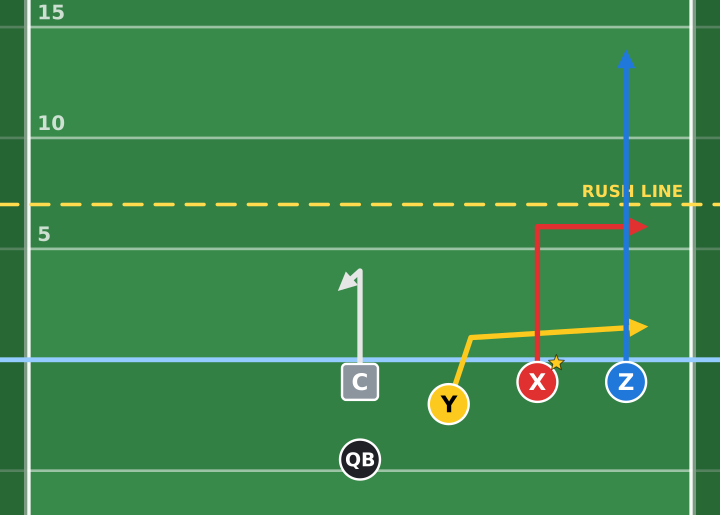 5v5 flag plays5 Simple 5v5 Flag Football Plays That Work (Free Printable Play Sheets)Five easy 5v5 flag football plays for youth teams, with diagrams, the quarterback's read for each, animated versions and free printable play sheets.
-
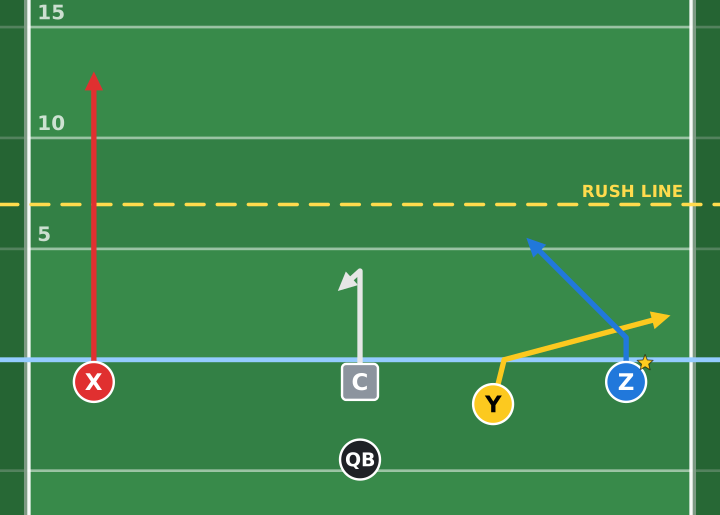 Wristband play cardsHow to Make a Football Wristband Play Card (Step by Step)How to make football wristband play cards that fit and read at a glance: choosing and numbering plays, sizing, printing and cutting, plus a free template.