 Play Designer
5v5 flag plays
5 Simple 5v5 Flag Football Plays That Work (Free Printable Play Sheets)
Five easy 5v5 flag football plays for youth teams, with diagrams, the quarterback's read for each, animated versions and free printable play sheets.
A good 5v5 flag play does three things: it spreads the defense out, it gives the quarterback one simple decision, and it gives every player a job. The five plays below do all three. Together they cover the quick game, a flood, a crossing route, a sweep and a red-zone play, which is enough to get a youth team through a season.
Every diagram here was drawn in Play Designer. Tap Watch it run under any play to see it animated in your browser, and grab the free printable play sheets at the end.
Before you start: 5v5 basics these plays assume
Rules vary by league, so check yours. These plays are built around rules that most 5v5 leagues, NFL FLAG included, share:
- Five players a side. On offense that is a center (C), a quarterback (QB) and three receivers, labeled X, Y and Z here.
- Everyone is eligible, including the center once the ball is snapped.
- The quarterback can't run with the snap. Anyone who takes a handoff or pitch behind the line can.
- Rushers start 7 yards back. The dashed yellow line in each diagram is that rush line. A short pass clock (many leagues use seven seconds) means the ball has to come out quickly.
- No-run zones near midfield and the goal line mean some downs must be passes.
How to read the diagrams: circles are players and the square is the center. The star marks the quarterback's first look. Arrows are routes, the zigzag line is motion, and the numbers on the left are yards from the line of scrimmage.
1. Slant-Flat
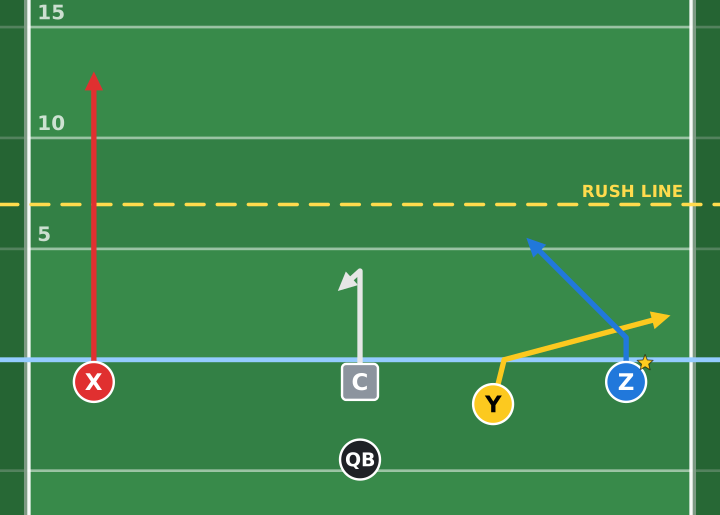
How it works. Z, the outside receiver, takes two steps and breaks in on a slant. Y, lined up inside him, releases to the flat underneath. X runs a go route on the other side to pull a defender deep, and the center sits at about four yards as the safety valve.
The read. The quarterback watches the defender between Z and Y. If that defender widens to cover Y in the flat, throw the slant behind him. If he jumps the slant, throw the flat. One defender can't cover both, so the ball is out fast.
Coaching tip. Young receivers round off the slant. Teach "plant and go": two hard steps up the field, plant the outside foot, and cut flat at a 45-degree angle toward the middle.
When to call it. First play of the game, any time you need 4 or 5 yards, and against a defense that plays off your receivers.
2. Flood
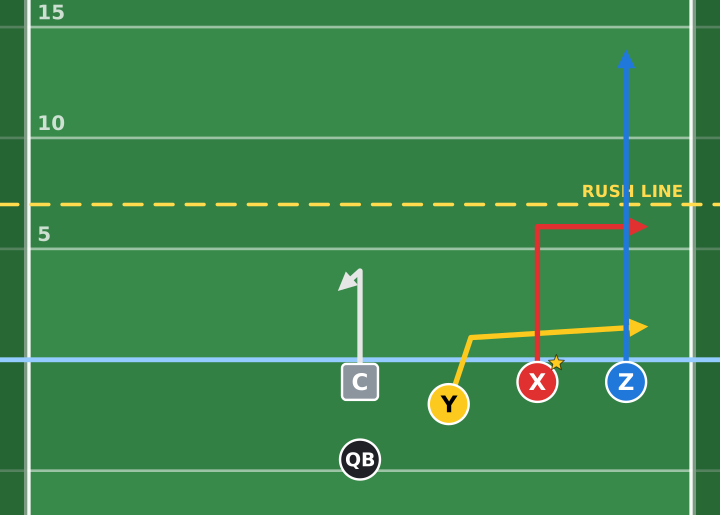
How it works. All three receivers line up to one side (trips right) and fill it at three depths. Z runs a go to take the deep defender away. X runs a 6-yard out, and Y releases to the flat underneath. The center runs a short route over the middle as the outlet.
The read. High to low. Look at X on the out first; if the defense sinks under him, Y is open in the flat. Against zone defenses, one of the three levels is almost always open, because there are more receivers on that side than defenders.
Coaching tip. The out is a timing throw. X should get to 6 yards, break hard to the sideline, and expect the ball right out of the break. Throw it to the outside shoulder so only X can catch it.
When to call it. Third down, or any time the defense plays zone. It also works well toward the wide side of the field.
3. Shallow Cross
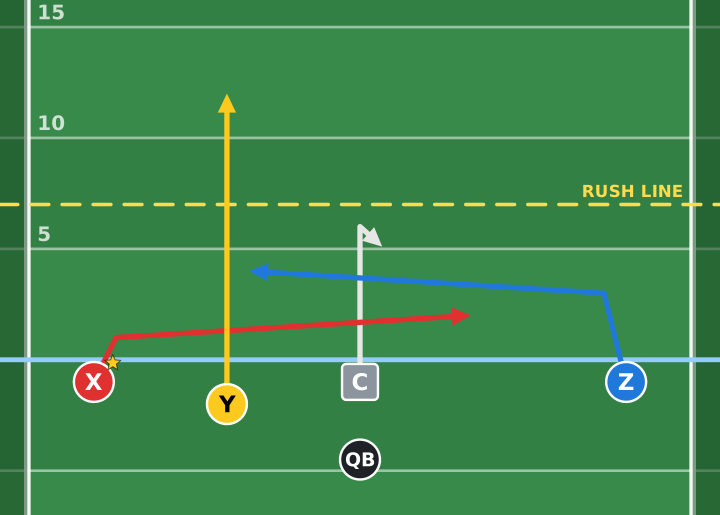
How it works. X and Z cross underneath from opposite sides, X at about 2 yards and Z at about 4, so they pass each other without colliding. Y runs a go to clear the deep middle, and the center sits at 6 yards.
The read. Against man coverage, defenders have to chase the crossers through traffic, and one of them comes open as they pass. Hit him on the run. Against zone, the crossers find the gaps between defenders and settle there.
Coaching tip. Teach the depths, and keep them the same every rep. Receivers should pass each other, not the defenders: deliberately running into a defender to free a teammate is a pick, and most leagues flag it as offensive pass interference.
When to call it. When the defense plays tight man coverage, and when your fastest player can catch a short pass on the move.
4. Jet Sweep
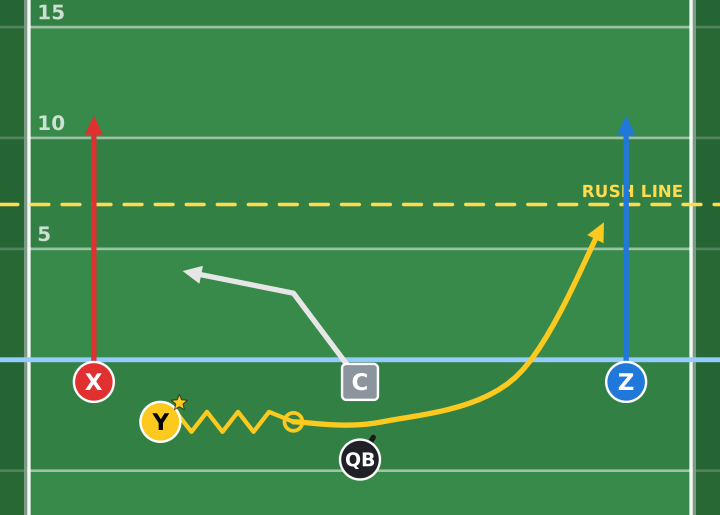
How it works. Y goes in motion across the formation. The center snaps the ball as Y reaches him, the quarterback hands it off, and Y sweeps to the right sideline. Z runs his defender deep, while X and the center run away from the play so their defenders follow them.
The read. There isn't one for the quarterback: it's a called run. Y reads the edge. If the defender there stays wide, cut up inside him; if he crashes inside, bend to the sideline.
Coaching tip. Timing is everything. Practice the motion and the snap until the handoff happens without Y slowing down. Most leagues allow one player in motion, moving sideways or away from the line, never toward it, and he must not cross the line before the snap.
When to call it. Against a defense that rushes hard, because the rusher runs past the play. Don't call it in a no-run zone.
5. Smash
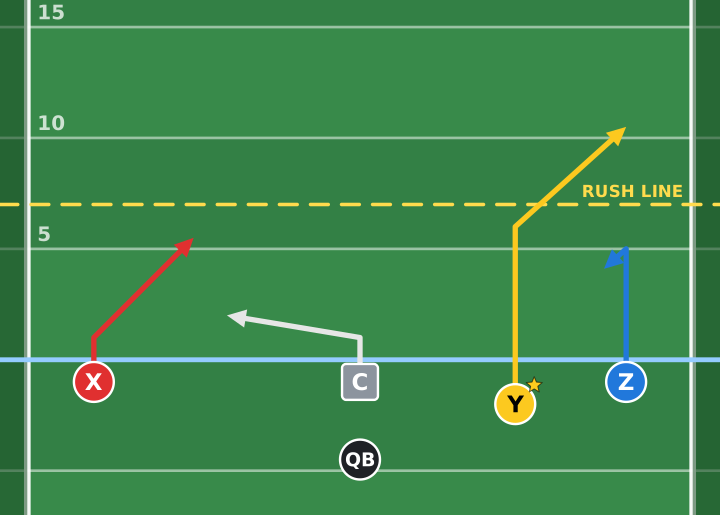
How it works. Twins right: Z runs a 5-yard hitch, turning back to face the quarterback, while Y runs a corner route over the top of him toward the back pylon. On the left, X runs a slant, and the center drags across underneath.
The read. Watch the defender over Z. If he drops deep with Y, throw the hitch. If he sits on the hitch, throw the corner over his head. If the right side is crowded, come back to X on the slant.
Coaching tip. The corner route has to stay wide. Y should break at about 6 yards and aim for the pylon, giving the quarterback room to drop the ball over the defender toward the sideline.
When to call it. In the red zone, and against defenders who squat on short routes.
How to install these five plays
Five plays is plenty for a youth team. Kids learn plays by running them, so give each one more reps than seems necessary:
- Walk through it. Line up and walk every route at half speed, with no ball. Each player says his job out loud.
- Run it on air. Full speed, no defense. The quarterback throws to the first read, then to the second.
- Run it against a defense. Coaches or players hold shields or flags; let the quarterback make the read for real.
Install two plays in the first practice and three in the second, then spend the next practices repeating them. Number the plays the same way all season so your calls never change: "1" is always Slant-Flat.
It also helps to let players see the plays before practice. Send the whole set as one team link and each player can watch every play animate on a phone, no app needed.
Free printable play sheets
The PDF below has all five plays on one page, then a full page for each play with the coaching points and room for your own notes. Print it for your binder or hand a sheet to each player.
If your players wear wristbands, there is also a sheet of these plays laid out as wristband cards. Our wristband play card guide shows how to size, print and cut them.
FAQ
How many plays do you need for 5v5 flag football?
Fewer than you think. Five to eight plays your team runs well will beat twenty plays it half knows. Start with these five, and add a play only when the team can run the current ones without thinking.
Can the quarterback run in 5v5 flag football?
In NFL FLAG and many other leagues, no: the quarterback can't run past the line with the snap. He can hand off or pitch to a teammate behind the line, which is why the jet sweep works. Check your league's rules.
What is the best 5v5 flag play for young kids?
Slant-Flat. It has two receivers, one read and a short throw, and the routes are easy to teach. Once your team runs it well, add Flood, which uses the same idea with a third receiver.
More coaching guides
-
 7v7 passing concepts7v7 Football Plays: 6 Easy Passing Concepts for BeginnersSix 7v7 passing concepts for beginners (Stick, Smash, Flood, Mesh, Four Verticals and Drive) with diagrams, the read and what each one beats.
-
Wristband play cardsHow to Make a Football Wristband Play Card (Step by Step)How to make football wristband play cards that fit and read at a glance: choosing and numbering plays, sizing, printing and cutting, plus a free template.